Education
Traditional Self-Service vs. Virtual Assistance: What’s the Best Choice for Your Business?
September 4, 2026 · 3 min read · VideFace
Self-service has radically transformed the way customers interact with businesses. From airport check-in kiosks and online banking to retail checkout systems and automated car rental platforms, consumers have become increasingly comfortable completing processes independently. Today, customers demand speed, unparalleled convenience, and the freedom to move through transactions without waiting in long, frustrating lines.
However, traditional self-service technology carries a critical limitation that many businesses overlook: What exactly happens when the system fails or the customer needs help?
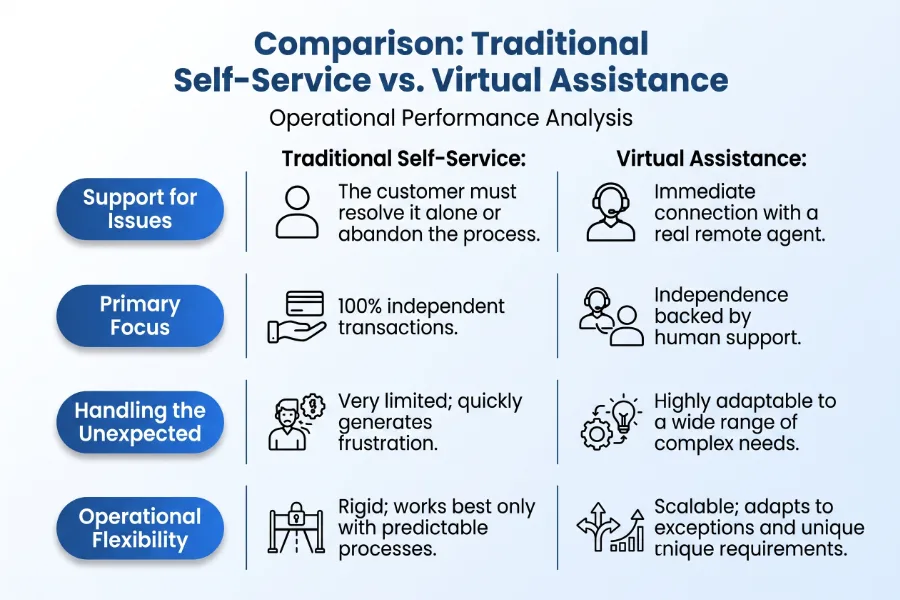
This is where virtual assistance completely changes the equation. While traditional technology leaves the customer to figure things out on their own, virtual assistance combines the undeniable efficiency of automation with immediate access to a real human agent. If your goal is to improve operational efficiency without sacrificing the customer experience, understanding the difference between these two approaches is your crucial first step.
What Is Traditional Self-Service?
Traditional self-service allows customers to complete a transaction or process independently, usually through a digital interface, kiosk, or automated system. The primary goal of this model is straightforward: to reduce the need for direct interaction with an on-site employee.
Common examples of this technology include:
- Interactive self-service kiosks.
- Online and mobile application check-in systems.
- Automated payment terminals.
- Digital reservation platforms.
- Automated pickup and return systems.
This model is extremely effective when the process is simple, linear, and predictable. The customer follows a series of on-screen instructions, provides the required information, completes the transaction, and moves on. For businesses, this successfully reduces wait times and optimizes front-line resources.
The Challenge With Fully Independent Self-Service
Automation shines when every interaction follows the expected "happy path." Unfortunately, real customer interactions are rarely 100% predictable.
What happens if an ID scanner misreads a document? What if a customer requires clarification regarding their reservation policies? Or what if a payment processing error occurs? In these situations, traditional self-service reveals its major weakness: the customer is left entirely alone in front of a screen to solve the problem.
This lack of support can quickly transform a tool designed to save time into a significant source of frustration, damaging brand perception. For business leaders, this creates a pressing question: How can you give customers the independence they demand without removing the human safety net when they actually need it?
What Is Virtual Assistance?
Virtual assistance takes all the convenience of self-service and adds the missing link: remote access to real human support in real-time.
Instead of requiring a business to maintain a fully staffed physical service counter at every location, customers can interact with a remote agent through the connected device whenever assistance is needed. This creates a much more flexible and resilient approach to customer service.
This hybrid approach seamlessly bridges two worlds:
Automation for efficiency: Technology simplifies repetitive processes, allowing the majority of customers to move through transactions rapidly without intervention.
Human assistance for complex situations: Remote agents step in only when a situation requires communication, empathy, clarification, or human decision-making.
Conclusion
The Future is Hybrid: Meet VideFace
The future of customer service is not about eliminating people from the equation; it is about building smarter systems.
At VideFace, our goal is not simply to replace human interaction with a cold screen. We develop technology that helps businesses modernize and systematize their front operations, reduce lines, and streamline customer journeys—while maintaining a direct line to real remote agents.
With VideFace, you give your customers total control of their time, backed by the reassurance that if things get complicated, expert human help is just a tap away.